
EDINBURG — In years past, the march toward Election Day brought discord to Carlos Cancino’s home in Edinburg.
“My wife and I used to get into big old arguments during the elections, because she doesn’t like Trump,” Cancino said. “And I was a Trump supporter. We used to literally fight and not talk for, like, several days.”
But this year, Cancino, a Latino small-business owner in the Rio Grande Valley, has done a political 180. Angry over the state of the economy and high prices, he has soured on Trump — and plans to vote for Democrats.
“Now I can’t stand the guy,” Cancino said. “I can’t stand the Republican Party.”
Democrats’ success in Texas this cycle will hinge in large part on how many Latino voters have come to the same conclusion as Cancino, who’s part of a critical swing population in a state that suddenly finds itself, after decades of Republican control, home to a tossup U.S. Senate race.
Just two years after major shifts in Latino voting patterns delivered President Donald Trump his largest ever margin of victory in Texas, affordability concerns and anger over the administration’s mass deportation campaign are fueling an expected swing back toward Democrats.

Gabriel V. Cárdenas for The Texas Tribune

The size of that swing, and where it shows up on the map, could decide whether Texas sends Ken Paxton or James Talarico to the U.S. Senate. And it will determine whether Republicans’ mid-decade redistricting pays off, after the Legislature redrew several congressional districts in majority-Hispanic South Texas with the intent of flipping them to GOP control.
But in interviews with over two dozen Latino strategists, organizers, candidates and voters in Texas, a common thread emerged: Any shift this year is less an embrace of the Democratic Party than a rebuke of the party in power — a reality that may persist for future elections with Latino voters established as a perpetual swing population.
“They’re not swinging back because they’re loving Democrats,” said Chuck Rocha, a Democratic strategist and Texas native working on numerous Democratic campaigns in the state. “They’re swinging back because Democrats are reminding them who broke it.”
In 2024, exit polls and precinct analyses estimate that Texas’ Latino vote split close to evenly between Democrat Kamala Harris and Trump. The shift was most evident in South Texas, where the president won all but two border counties and flipped major population centers like Cameron and Hidalgo counties for the first time in decades. Riding economic anxiety over inflation and persistent high prices, as well as frustration over migrant crossings at the southern border, Republicans at the top of the ticket hit new highs with Latino voters.
This fall’s election will test how solid the floor is. Latino Texans who loosened their ties to Democrats are not automatically coming home, strategists said, despite the discontent with Republicans captured in polling. Democratic candidates, saddled with a damaged party brand, will have to win over Latinos who feel let down by both parties, running on the strength of their own message.
“The conversations we’ve had at the doors with voters have very much implied that disillusionment with Republicans doesn’t translate into automatic Democratic support,” said Ricardo Rauseo, the national press secretary for Somos Votantes PAC, which is on the ground in several majority-Latino U.S. House districts in Texas. “Instead, they’re looking for candidates that are authentic and that are actively presenting and communicating a vision for the economy.”
Still, the GOP faces significant headwinds with Latino Texans that were not part of the picture two years ago.
High costs remain a frustration — particularly gas prices in the aftermath of Trump’s decision to attack Iran, disrupting Middle Eastern oil flows. The border has quieted, a welcome change for many in South Texas. But the discussion around immigration politics has moved to the interior, where a spate of violent incidents involving Immigration and Customs Enforcement, including the shooting of a Latino man in Houston, have sparked allegations of anti-Hispanic racial profiling. In South Texas, ICE enforcement has also disrupted the local economy, especially the construction sector, a source of frustration in a growing region.
That combination has left Latino Texans angry at politicians writ large, said Mario Guerrero, a three-time Trump voter who will be voting for Democrats this cycle. Guerrero, the executive director of the South Texas Homebuilders Association, said that anger starts with Trump, who he said has made Latinos in South Texas feel deceived.
“I just feel like we need people to call out our politicians and just tell them to cut the crap,” Guerrero said. “We’re tired of this shit. We’re not your puppets, and that’s what they have us as right now.”
Amid this climate, polling has found Trump’s popularity taking a nosedive with Texas Latinos, 34% of whom said they approved of his job performance in an October CBS News poll. That was 11 percentage points below his overall standing in the state.
That’s where Democrats’ economy-focused message is resonating with Latinos, Rocha said, adding that it’s landing because of the simple fact that they’re not in Trump’s party.
“The price of gas and groceries message is just where people are, and it’s the reason they’re swinging back,” he said.
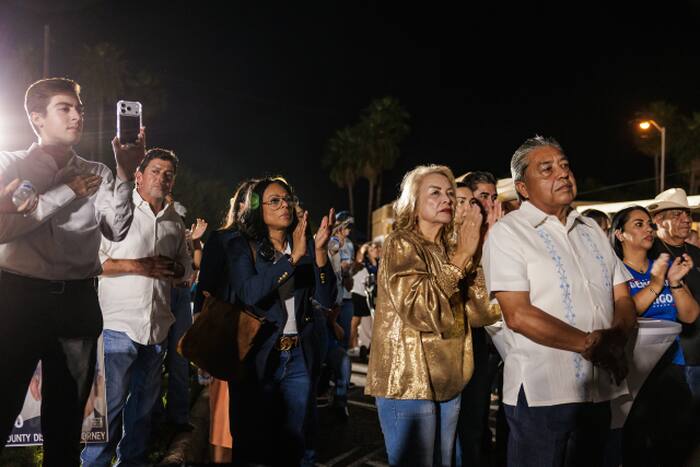
At a get-out-the-vote rally in Donna in early October, local Democratic candidates took to the microphone to hype up a mostly Latino crowd of hundreds. They were met with cheers when discussing their campaigns and loud boos when Trump or Gov. Greg Abbott came up. Multiple generations of families lined up for food and crowded around Democratic congressional candidate Bobby Pulido, a Tejano music star, when he arrived. The rallygoers were, to use the parlance of the internet, libbing out — South Texas style.
Speakers talked about how their candidates would represent la raza and argued that Republicans in Texas and Washington had corrupted the promise, instilled in them by their parents, of hard work paying off. And they implored attendees to vote.

“If we look at history, if we look at how people have voted in the past, it’s been very low percentage,” said Ricardo Rodriguez, the former Hidalgo County district attorney. “There’s a high amount of voter registration here in Hidalgo County. If us and El Paso would come out and vote during the early voting, man, it’s over. Texas will turn blue, ladies and gentlemen!”
For years, Democrats had banked on improving Latino turnout and the growth of the Hispanic population — now the largest demographic group in Texas — to deliver them majorities. But Republicans’ inroads with Latinos upended that prophecy.
This time, strategists and organizers see three trends that could finally break the GOP dam: dampened turnout among Latino Republicans, a sizable shift toward Democratic candidates among Latino Trump voters and heightened enthusiasm among Latino Democrats. That last trend will matter especially in the state’s major urban centers, where Democrats believe they can gain significant ground on turnout alone in places like Houston, San Antonio, Dallas and El Paso.
For a population that is younger and more working class than Texas as a whole, economic frustration and a sense of indignity over ICE is creating an unprecedented “Molotov cocktail” of enthusiasm, said Jaime Mercado, a Democratic strategist in Houston.
Just as important, if harder to see, is who is not talking about the election.
“There’s going to be a lot of folks who are just going to go to the polls, and frankly, just quietly make a mea culpa vote,” Mercado. “I personally know there’s people in my family who are not talking about it, they’re just giving me the quiet signal — I’m going to go make up for this.”
Whether or not that anger translates into votes for Democrats will be a decisive question for 2026. Strategists said they see Latino voters being driven more by individual candidates than party affiliation this cycle.
Stephanie Valencia, co-founder of Equis, a Democratic-aligned firm which conducts research and polling on Latino voters, said people want to break with the party’s “brand” and “the past,” and successful Democratic candidates in South Texas “represent both of those things.”
“I actually think these guys represent a new brand of moderate anti-establishment candidates, that are bucking the brand and bucking the past, but are doing so in a kind of moderate and centrist way,” Valencia said.

The instinct to judge candidates beyond their party label is familiar to South Texas voters. Even amid the GOP’s historic performance in 2024, down-ballot Democrats in the region, including congressional candidates, won their races. Those outcomes showed Latino voters’ willingness to split their tickets and the Democratic Party’s enduring strength at the local level.
Equis’ September polling of likely Latino voters in Texas found an electorate poised to revert to the levels of support Beto O’Rourke won in 2018, when he captured 64% support from Latino Texans, according to exit polls. Talarico; state Rep. Gina Hinojosa, the Democratic nominee for governor; and the generic congressional Democrat each received between 62% and 64% of the Latino vote. Other polls have been less rosy, suggesting a wide range of outcomes. Rocha projects the Texas Latino leftward swing will land between 10 and 25 percentage points.
In focus groups put on by Equis, numerous Texas Latino voters said they connected with Talarico’s faith and economic message, which centers on fixing high costs and a broken system in which the top earners have made it impossible for others to get ahead. Hinojosa, a Latina from the Valley, has been similarly razor-focused on the economy and corruption. And Pulido, with his celebrity and an economic message that celebrates building generational wealth rather than demonizing the rich, is among Democrats’ most prized recruits this cycle, and a candidate they believe can uniquely speak to Latino men, who shifted sharply to the right in 2024.
“For Democrats, the concern about Latino men and support there continues,” said Julián Castro, the former San Antonio mayor and U.S. housing secretary who now serves as the CEO of the Latino Community Foundation. “I think that they’re going to have to find ways to be able to connect with that community. They’ll do better in 2026, very likely, than they did in ‘24. But they have to build on that. Bobby Pulido can be helpful in that regard.”

Robert San Miguel, a political independent in Temple, is one such voter motivated by individual candidates. San Miguel voted for Trump in 2020 and in 2024, motivated in part by his support for tighter immigration policies. But he no longer backs the president, saying Trump lied about his commitment to keeping the United States out of foreign wars.
But San Miguel’s frustration does not make him a reliable Democratic vote. In the Senate race, he said he is disturbed by allegations of corruption against Paxton and will vote for Talarico, while planning to split his ticket.
“I disagree with some of his views, but I actually think he’s a pretty decent person,” San Miguel said. Abbott, by contrast, has “not done anything horrible for Texas,” so San Miguel plans to stick with him.
Jorge Martinez, a Texas-based adviser and spokesperson for LIBRE Action, a conservative Latino voter outreach group, has spent 14 years organizing in the Rio Grande Valley, working to convince Latinos that the Republican Party — of low taxes, faith and protecting oil and gas jobs — should be their home.
“They’re natural conservatives,” Martinez said. “The thing here is that historically, it’s just because, oh, grandma voted this way, or mom voted this way. So people are just sticking to tradition or their custom. But we’ve seen some breakthroughs on that, where people broke through the party lines last cycle. But down ballot, they still voted Democrat.”

Martinez’s optimism this cycle comes from hearing the same candidate-over-party ethos Democrats are counting on. He sees it as an opportunity to break Democrats’ down-ballot hold on South Texas. While doorknocking for Republican congressional candidate Eric Flores, who is running in a majority-Hispanic seat from Brownsville to Corpus Christi, Martinez said he had conversations with six voters his group had identified as persuadable. Of those, he said four backed Flores. A fifth voter said little, and the sixth planned to vote for Democrat Vicente Gonzalez — but would have been open to Flores had he not received Trump’s endorsement.
The national environment, Martinez acknowledged, is an obstacle for the GOP.
“The challenge right now for Republicans is that they control the Congress, the Senate and the White House,” Martinez said. “[And] things are still expensive. They haven’t gone down like people had hoped for down here.”
Wayne Hamilton, a Republican operative who runs Project Red TX, a group focused on building GOP political power in South Texas, sees a similar anti-incumbent mood. He said it could simultaneously hurt Republicans in federal races and Democrats at the local level.
“In this particular election, there’s going to be voter retribution at all levels,” Hamilton said. “There’s no question about that, and it’s going to cut both ways.”
Hamilton compared Republican efforts in the region to the stock market: Some years are up, some years are down, but the overall trend, he believes, is positive.
Hispanic Republican candidates in competitive majority-Hispanic South Texas districts, including Carlos and Monica De La Cruz, have at times leaned on their own working-class backgrounds on the trail, acknowledging they feel the pain of gas and grocery costs. They’ve also tried to tie their Democratic opponents to the most unpopular parts of former President Joe Biden’s agenda.


Other Republicans have doubled down on culture-war issues in their quest to keep Latino voters in the tent. Spanish language ads from pro-Paxton super PACs have made hay of Talarico’s viral comment that “God is nonbinary” and claimed he supports minors receiving gender transition procedures. Talarico has said his past comments on some culture war issues “missed the mark” and that he opposes gender reassignment surgery for minors.
To be sure, Democrats and Republicans alike agree that the GOP’s gains with Latino voters, especially in South Texas, were not a mirage. Democrats say it’s unlikely they’ll return to their 2016-era margins, when Hillary Clinton won over 70% of the vote in places like Webb County, home to Laredo, and Starr County, home to Rio Grande City.
“I think we’ve lost some forever, that will probably not come back,” said Jose Borjon, a Brownsville native who worked for six South Texas Democrats in Congress. “But I think the majority of them are persuadable — are people that can come to us. And I think what they’re seeing now — and these are people in their 30s, 40s and 50s — well, the economy’s not better. Gas prices have gone up. We’ve gone to war for reasons that we don’t really understand.”
Even if a blue wave materializes, several Latino Democrats cautioned the party against assuming its gains still stick. Of the Latinos who return to the Democratic fold, many will do so out of anger at Trump, Borjon said — and Democrats are benefiting from being the only viable alternative.
Guerrero, the homebuilders’ association director who is voting for Democrats this cycle, said he expects Latinos to remain a swing vote as long as immigration and border policy continue to be used as political tools.
“I think people are tired of both the right and the left,” Guerrero said. “I think we need peace. But what’s going to happen is, you’re going to see the pendulum swing from the right to the left. And when it swings that hard, we’re not going to be in the middle.”


