
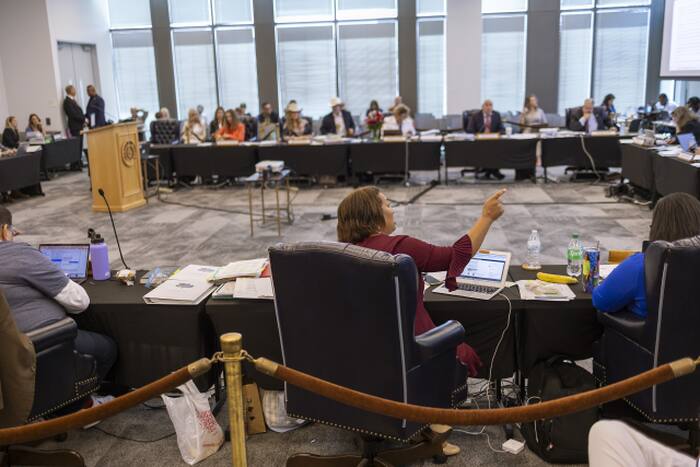
In the moments leading up to the Republican-dominated State Board of Education finalizing a rewrite of social studies lessons this summer, Will Hickman proposed a minor change.
A majority of board members had preliminarily approved a requirement that public school students learn about the Prophet Muhammad’s “brutal military campaigns against Jewish and Christian tribes, the normalization of slavery, and the taking of female captives as harem slaves.”
Deviating from some of his GOP peers on the board, Hickman, a Houston Republican, sought to strike the word “brutal.”
“I think we can all agree, military battles and wars are all brutal,” he said. “But we have not described any others that way.”
After pushback from Brandon Hall, a board member more politically right of Hickman, an 8–4 majority rejected the proposal to remove “brutal.” At least three of the board’s appointed experts objected to the broader characterization of Islam over concerns about historical accuracy.
While Hickman’s proposal was unsuccessful, it captured a dynamic on the education board that could largely dissipate after the November election.
Board members often vote along party lines, as Republicans currently hold an 11–4 supermajority. But on the most divisive topics, some conservatives have shown a tendency to deviate from their colleagues. That played out, for example, when the board discussed learning materials that teach Bible stories. It happened again when the group deliberated on the renewal of a Native Studies course. And it occurred during recent debates about how Texas should approach social studies.
During early voting and on Election Day, Texans will not see three of those Republicans on the ballot after they decided not to seek reelection. Republican candidates vying to replace the incumbents appear to embrace a brand of Christian conservative politics that values party alignment more than consensus and camaraderie, with tens of thousands in special-interest money fueling their campaigns.
The absence of members willing to deviate from their peers could prove consequential in the coming years when the board rewrites math standards and debates which social studies textbooks to approve. Their departure, advocates warn, also opens the door for far-right Republicans to cause more disruption during meetings and approve more changes that do not reflect the diversity of Texas’ 5.5 million public school students.
“It’s going to be, probably, the most divisive that the board has ever been,” said Rocío Fierro-Pérez, political director of the progressive Texas Freedom Network, an organization serving as a watchdog over the State Board of Education.
Hickman, the Republican who suggested the minor social studies change, noted that most of the board’s work is nonpartisan. But he also believes the group is more divided now than it was when he took office in 2021.
“If a board member is trying to score political points one way or the other, it kind of distracts from the work of the board,” Hickman said. “There’s people who bring politics into the room. My view is it generally doesn’t belong.”
Working on the board consumes a significant amount of family, work and personal time, which Hickman said factored heavily into his decision to not seek reelection.
Frisco Republican Evelyn Brooks, a board member since 2023, said she planned to run for another term if she had not campaigned for governor, a race she lost during the March primary.
Brooks acknowledged the significance of her and her colleagues’ departure, adding that some members focus more on fulfilling the desires of donors and political groups than on making decisions in the best interest of children.
The board needs more balanced representation to ensure that members put kids first, she added.
“People will say you’re not a real Republican or you’re not this or that. Children don’t care about what you are when it comes to education,” Brooks said. “Any one group of people with a majority of the power can be a destructive thing.”
Keven Ellis, a Lufkin Republican not seeking reelection, did not respond to questions for this story.
Nine seats are up for election this year, including the three that belong to consensus-minded Republicans. A fourth closely watched seat is currently occupied by a Republican who lost in the March primary. That seat was previously held by a Democrat.
Tiffany Nelson, the candidate running for Hickman’s spot, previously served as a Conroe school board member, where her children attend school. She attracted local attention as one of the “Mama Bears” who led a Christian conservative charge against “inappropriate” library materials and transgender students using restrooms that do not align with their sex assigned at birth. “Critical Race Theory, gender ideology, and anti-American narratives have no place in Texas schools,” her campaign website states.
Kason Huddleston, a pastor running to replace Ellis, said on a recent podcast that Islam, socialists and leftists “have weeded their way into the curriculum.” He claimed that some young people hate America and Israel because “they were not taught who they were.”
In explaining the history of the board, Huddleston pointed out that despite a comfortable GOP majority, the group was previously unable to pass what Republicans wanted because a handful of them voted with Democrats. He urged voters to support the conservative ticket.
Mindy Bumgarner is the GOP candidate looking to replace Brooks. Married to a Republican state representative, Bumgarner’s platform notes her commitment to “promoting transparency, protecting parental rights, and keeping radical political agendas out of our classrooms.” Her website strays away from political buzzwords such as “woke education” and “liberal indoctrination,” unlike her counterparts’ platforms. But she stands in alliance with elected officials fighting to “stop the woke agenda in our schools.”
Bumgarner, Huddleston and Nelson did not respond to interview requests.
Running opposite the three Republicans are Michelle Palmer, Ericka Ledferd and Amy Taylor, all Democrats with active backgrounds in education. Palmer and Taylor currently teach in K-12 public schools, while Ledferd teaches in a summer program at Southern Methodist University designed to assist underrepresented students.
“Teachers see what’s happening, and they’re kind of sick of it,” Palmer said. “They’re tired of what’s going on, and they want to fix what’s happening so that their students have a decent chance in life.”
The Democratic candidates criticized Republican board members’ decisions to paint Islam in a negative light, their insistence on incorporating Bible lessons in learning materials, and the lack of teacher voice in decision-making.
They believe the board has swayed too far into politics at the expense of student learning. While they disagree with the three Republican incumbents on a number of issues, some of them commend the members’ ability to reason and compromise. The State Board of Education should stand as an advocate for public education, they say. Not actively work against the needs of the students who occupy it.
“We need prepared people at the board with some type of educational background,” Ledferd said, “instead of ideologues who are acting on behalf of a party or a religion.”
The three Democrats face an uphill battle to win their races. The Texas Legislature years ago redrew political maps to their disadvantage, and their Republican opponents have received significant campaign donations from groups pushing for more conservative values in the classroom. For example, the conservative group Texans for Educational Freedom donated nearly $100,000 to Huddleston’s campaign. Ledferd, his opponent, has raised just short of $5,000.
A fourth seat serving the Rio Grande Valley, where Republican incumbent LJ Francis lost in the March primary, is less certain. That district previously leaned Democrat before Francis narrowly won in 2022.
Victoria Hinojosa, the Republican nominee for that post who is a Coast Guard veteran and the wife of a state senator, did not respond to requests for an interview. She is running against Thomas Ray Garcia, a former high school teacher and current English professor.
“I’m very distressed at what I’ve seen within the board,” Garcia said. “There is tension, drama and clownish behavior that is on display for the public to see, and it gets in the way of bipartisan support for common sense measures.”
Financial advantages in State Board of Education races, a body not well known throughout the state, can lead to more advertising. And name recognition makes a difference at the ballot box.
But the Democratic candidates hope their door-knocking and handshaking will lead to success on Election Day. If elected, the candidates will have their hands full juggling classroom responsibilities and unpaid board duties.
They consider preserving the integrity of the board worth it.
“We’ve had a history of people who are willing to sacrifice for good things, for the better of our community,” Taylor said. “I’ve been the recipient of great education, and I don’t want to let it go. I’m just not willing to give Texas public education over to ideologues. I’m just not willing to do it without a fight, because I care about it too much.”


